

The Spark (must read for every mom)

The storm had come suddenly, sometime between sandwiches and schooltime, and the branches banged against the house, and the lightweight lawn-chairs did flips across the lawn. The storm was just severe enough to be fun.
“May we please go play in the wind before math?!”
It was respectfully asked, and there it was in his eyes, the spark.
I bent down and smiled straight into that spark: “Ten minutes. Ready? GO!”
A blur of boots (no time for a coat!) ran out the door, and I watched from the kitchen window as they ran across the yard, flapping arms and laughing, feeling the powerful gusts push them along.
I glanced back at the book there on the counter, ready to be returned to the library, and gratitude welled up in me again for Kristine Barnett’s message to all moms: {Read the rest over here … THANK YOU!}
The day I walked out on my family…
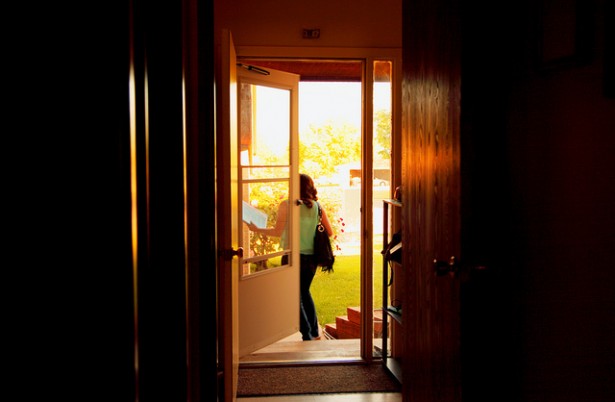
And then I can’t believe it but I grabbed my purse and keys and walked right out the door, without a word.
It felt terrifying and sickening and freeing and thrilling all at once.
All week it had built. Responsibilities. Company. Engagements. Needs. And I had smiled. And I had welcomed. And I had prayed. And I had studied. And I had cooked and cleaned and taught and read and listened and bathed them and kissed them and loved him and picked up a gazillion stupid items off the stupid filthy floors and folded towers of their laundry and then that one day they were all grumpy–all of them–and that was just it. Enough already.
Terrible words ran through my mind.
But none of them left my mouth. I fled, silent, so the kids didn’t even know, and it was all of 5 minutes I was gone, but it still felt daring and dark and dangerous because I didn’t take my phone and away I drove, not knowing where, and I knew, just for a moment, he would wonder where I went.
And maybe someone would notice: She’s crumbling.
So I pulled over all of five blocks down the road, at the park, and sat and prayed, knowing it would pass but still somehow trapped in dark thoughts–terrible ones. How can his lies get so wrapped around our minds? How can I KNOW I’m in the middle of spiritual warfare yet be so utterly incapable of crawling out? How can a silent battle be so brutal?
And that was just it. Silence. I couldn’t say the things I felt. Not without lasting damage. But the silence kept everything in. Dark thoughts, kept in darkness, fester.
Light comes in through letting it out … loud.
And so I said it all, out loud. To God. All the dark thoughts. The terrible ones. And out it spewed, loud, into the empty car, and the sun slanted in through the side window and suddenly the darkness was … gone.
And it wasn’t all perfect. But the power of darkness is gone when the light comes in. And somehow it was easier to sort through it all once it all came out. Like pulling out the contents of a drawer in order to organize. Emptying a closet to toss out what you don’t need. You can’t sort through it when it’s all shoved in the darkness.
And so confession–out loud–lets in the light and lets Him sort through it and lets Him shed His love over it all and let’s His wisdom give discernment: What to share with others and what to let go. And so I returned. And the words, calmer now, more gentle, more kind, more loving, were spoken. Truth and grace. And we broke through. Fog lifted (he’d felt it too). Joy returned. Clarity restored.
That night we read The Silver Chair and the witch, the Queen of the Underworld, slowly pulls Scrubb and Jill and Puddleglum into her spell, getting them to believe that there is no Aslan, there is no sun, there is no hope. And at first they resisted, for they knew they were being enchanted, but then of Jill it said:
“This time it didn’t come into her head that she was being enchanted, for now the magic was at its full strength; and of course the more enchanted you get, the more certain you feel that you are not enchanted at all.” (153)
And Jeff stopped reading, mid-sentence, and said: “Yes. The more we are entangled in the enemy’s deception, the more certain we feel that we are not deceived at all.”
And so what do we do? Get alone with God and get loud. Speak out. Confess. Pray. Read truth out loud.
So while I don’t recommend running out on your family, a bit of alone time in the car might do a bit of good, if you’re all tangled up in confusion or despair. Silence is like darkness. Let in the light by letting it out … loud.
{Remember this from last year. Praying this can be freedom for someone as you face the week. Have a blessed Monday, and thanks for reading.}
The blessing of a good enemy

Sometimes a good enemy is our greatest asset.
We seldom think so though, right? I know if someone comes “against” me so to speak, whatever the situation, my first inclination is not to rejoice. We bristle under criticism and balk at those who don’t agree with us, brilliantly crafting arguments for why we are SO right (and awesome).
This weekend Jeff taught that we tend to be blind to our own faults, but hyper-aware of others. If someone else lies, “They’re a liar!” If we lie, “Well … it’s complicated.” Ha! Last year I read the phenomenal book I Told Me So, a brilliant look at our own tendency for self-deception. It’s a fabulous read–worth your time!
What does this have to do with our enemies?
Well, our enemies are actually our greatest asset in our venture to live free(r) or self-deception, to live a life of authenticity and integrity, actually being who we want to be. How so?
I recently was in an interpersonal challenge, and was struggling to love. For nearly a week, I was in default mode, i.e. coming up with a hundred arguments why I was right (and awesome) and another person was wrong (and not awesome). Somewhere along the line, however, God was so gracious and suggested to my heart that I go ahead and see myself the way this other person sees me. That is, the way my enemy sees me. He invited me to imagine, just for a moment, what that person would say if he or she was allowed to tear me apart limb for limb.
*Cringe face here*
Now some of you are shaking your head right now: Not a good idea, you are saying. I’m not advocating that we always see ourselves through the eyes of enemies, or that we doubt for a moment that we are loved and precious and accepted by God. That’s not what’s going on here. What I’m suggesting is that our enemies are actually helpful because they help us see our blind spots, the area of obvious sin or weakness, that we might be hiding from ourselves.
So I did this. It was so good.
Notice I didn’t say it was fun. But it was good. It helped me see some areas of pride and hypocrisy that, deep down, I knew my “enemy” (using that word loosely!), would spot in a split-second.
The benefit of this exercise was 2-fold. It highlighted some areas where my character really needs work. Really. But secondly, it helped me see the entire situation through the perspective of this other person and realized, “Wow, no wonder this person feels like that.” Not only that, this led me to consistently pray for this person out of a heart of love, genuinely asking for blessing, and the next thing I knew the “interpersonal challenge” began resolving!
Interpersonal insight AND increased empathy AND relational reconciliation. Wow, that’s a great deal!
And it all started with just listening a little closer to an enemy.
Of course I’m sure I’ll still bristle and balk and brilliantly craft self-promoting arguments the next time I face an enemy, but I pray God helps us be just a little quicker to see our own short-comings through the eyes of those who may not be a big fan of us.
And I pray we ask God to help us live in such a way that even our enemies have nothing against us, that our lives lead those around us to glorify God (1 Peter 2:12).
God give us the humility and grace to live this way. For your glory. Amen.
{Thanks for reading.}
Why Brokenness is a Blessing

Remembering this…
“Nap time, babygirl! Come here, please.” From across the room I could see her stiffen, prepare to protest. I gave her fair-warning. “Make a good choice. Will you say ‘yes’ or ‘no” to Mama?” There was no need to remind her of what a ‘no’ response would earn. She knows.
She stiffly, and slowly, walked over to me. Her mouth said yes and she made her feet move, but her face and demeanor were “no-ing” all the way. I picked her up, took her to the potty, and told her to go before her nap. She sat down, didn’t go, said she was done.
Outwardly obedient but deep-down defiant.
I took her into her room for the rest-time routine. Rock, snuggle, sleep. I pulled her up on my lap in the rocking chair, but she pushed away. Again, silent, but stiff as a board and at arm’s length. I carried her over, crawled under the quilt at her side. She lay still for a moment, then a mischievous look came across her face.
“I need go potty.” I knew it. Kids will use anything to control. To defy. I was choosing this battle and wouldn’t lose. She’s beautiful, but manipulation is not a beautiful quality when it’s all grown up. I kissed her cheek and looked her in the eye.
“No. Mommy already told you to go and you didn’t. You’re not getting back up.” She fussed again, insisted she has to go, begins to pitch a fit. I think to myself how I don’t want to change wet sheets.
But I’ll change her sheets in order to change her heart.
“No.”
Her eyes widen as she realizes it’s a lost cause. She can’t win because I won’t budge. And almost visibly, right before my eyes, I can see the cracks, then the crumble. I can see her break.
She’s broken. She sobs.
And almost in the same breath-sob she reaches both arms out, wraps them around my neck.
She clings hard, pulls me close, and cries,
“Mama, I wan’ keep you.”
She wants to keep me. These are the words she uses at night when she longs for me to linger. She squeezes me tight round the neck and holds on, says she wants to keep me. Won’t let me go.
I, of course, don’t pull away.
I draw her even closer into my arms.
She’s soft. Pliable. She rests, relaxed in my arms. I hold her, my arms all the way around her little body as she rests in her bed. Even though I’m crouched over, quads burning, I stay there, my head on the pillow next to hers, kissing her cheeks.
Within two minutes she’s sound asleep.
That’s me, I think. That’s me.
Why often do I stiffen, proud? Willing my feet and mouth to say yes to God but protesting no within my heart? Every time I choose myself, my own way, I push Him away, hold Him at arm’s length. He seeks to rock me gently, I stiffen and push Him away. He draws near to hold me. I talk to Him perhaps but my prayer is still just grasping for control. But then something jolts, cracks, crumbles.
This is how we break. This is why brokenness is a blessing.
The sacrifices of God are a broken spirit; a broken and contrite heart, O God, you will not despise. (Ps. 51:17)
Of course He won’t! Of course He never will. The same way that I hold my broken-spirit daughter, envelope her completely, engulfed in my love until she falls sweetly asleep. Until she rests in my love.
Why do we push Him away? Our pride, the God-repellent, it stiffens within us, incites us to rebellion, but we must make it bow. Must make our feet and mouths and hearts say “yes” to God.
Then, no matter how far away He feels, He will envelope us in His love and let us rest secure. And resting secure we discover the truth:
Brokenness is the only path to wholeness.
–
{Praying blessed brokenness–and wholeness–for you and me this week. Can you let go and rest in His arms? He loves you so!! Thank you for reading.}