

To be or to be known? (Shifting the focus.)

It took me by surprise the first time I read the billboard advertising the MBA program for a well-known Christian university in our area:
BE KNOWN AS A TRUSTED LEADER.
Hm. Ok. That’s good. Trusted leaders are good. Goodness knows we could use more trusted leaders in the business world, and I’m glad that this university is training a few. However, two words bothered me, they stood out awkwardly out of place, inappropriate.
KNOWN AS?
Be known as a trusted leader? Is that the most important goal? Isn’t the real goal to be a trusted leader? Is it more important to be a trusted leader or be known as a trusted leader?
I get why they advertise that way. Appealing to the business world, it is important to be known, recognized–that’s how you earn business. But ultimately, for a believer, even a believer in the business world (since there’s no sacred-secular duality!), isn’t it more important to be something than to be known as something?
I’m not throwing stones here, at least I’m not throwing stones that I haven’t already thrown at myself. A few months ago I was reading The Lost Art of Listening, and reading some convicting material on learning to listen well. The author pointed out that most of us want to be “good listeners” more than we want to actually listen.
See the difference? Where is the focus?
On us.
Ouch.
When I want to “be a good listener” what I’m really wanting is for people to think of me as good listener. I want them to want to talk to me, to value me, to think I’m a good friend. The author even goes so far as to point out that sometimes while we’re listening we’re actually thinking about ourselves and how we’re trying to be a good listener. We can have all the right responses–nodding the head, saying mmhmmm, and making eye contact. But as long as we are focused on ourselves, We’re not truly listening.
We cannot truly listen and empathize until we suspend our focus on self and choose to focus solely on that person.
And, I would suggest, we cannot be trusted leaders until we quit trying to “be known as a trusted leader” and begin focusing our attention on the needs of others and how we can serve them through leading them to Christlikeness, wholeness, health. As long as our focus is on ourselves, we aren’t much use as a leader!
It’s subtle, but it’s a small and important steps toward growing more like Jesus. He is the ultimate example of suspending self for the good of others (Phil 2). Instead of being known as a good church, I want to be one, serving people and leading them to the cross. I don’t want to be known as a good wife or mother, I just want to be one. Serving the needs of my man and my kids, helping them become more and more like Jesus. I don’t want to be known as a good friend, I just desperately want to be one, providing strength and support and love to those I am honored to name friend.
Friends, we can never go wrong when we take small steps to continually shift the focus off ourselves and onto Christ and others.
Whether or not we’re known for it, let’s be it. Amen? Amen.
{Thank you so much for reading.}
As you walk along the road today …
On one occasion an expert in the law stood up to test Jesus. “Teacher,” he asked, “what must I do to inherit eternal life?”
“What is written in the Law?” he replied. “How do you read it?”
He answered, “‘Love the Lord your God with all your heart and with all your soul and with all your strength and with all your mind’; and, ‘Love your neighbor as yourself.’”
“You have answered correctly,” Jesus replied. “Do this and you will live.”
But he wanted to justify himself, so he asked Jesus, “And who is my neighbor?”
In reply Jesus said: “A man was going down from Jerusalem to Jericho, when he was attacked by robbers. They stripped him of his clothes, beat him and went away, leaving him half dead. A priest happened to be going down the same road, and when he saw the man, he passed by on the other side. So too, a Levite, when he came to the place and saw him, passed by on the other side. But a Samaritan, as he traveled, came where the man was; and when he saw him, he took pity on him. He went to him and bandaged his wounds, pouring on oil and wine. Then he put the man on his own donkey, brought him to an inn and took care of him.The next day he took out two denarii and gave them to the innkeeper. ‘Look after him,’ he said, ‘and when I return, I will reimburse you for any extra expense you may have.’
“Which of these three do you think was a neighbor to the man who fell into the hands of robbers?”
The expert in the law replied, “The one who had mercy on him.”
Jesus told him, “Go and do likewise.”
Martin Luther King Jr. reflected on this story: “The first question that the priest … and the Levite asked was, “If I stop to help this man, what will happen to me?” But the Good Samaritan … reversed the question: “If I do not stop to help this man, what will happen to him?”
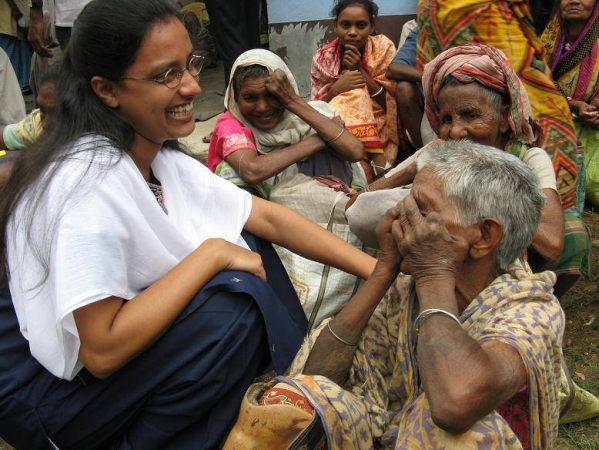
Perhaps right now you are walking along your day. Cruising right on through. You’re about to make breakfast or perhaps you’re on lunch break, or you just tucked your children (finally!) into bed for the night. And perhaps as you walk along the road, just one click will enable you to see that there is a man or woman or small child lying on the side of the road, right where you are walking through your normal day today. Perhaps as you click again you’ll be able to see the person’s face, and see that they are in need. Perhaps a few more clicks will enable you to virtually kneel down, embrace them, help them up, and by prayer and a few dollars, get them to a place of help, healing, wholeness.
All that can happen from where you sit right now.
Will you take a moment, right now, to stop along the way?
I was recently acquainted with Gospel for Asia’s Compassion Ministries. Through these links we are able to virtually kneel down and help those, the wounded man, woman, or child along the road, who desperately needs love and medical attention. Will you take a moment to click through these links and acquaint yourself with the sweet opportunity to love the way Jesus loved? Thanks for suspending your own needs, just for a moment, to give a hand up, and love someone through practical means, in Jesus’ name. Thanks for reading.
Compassion Services Main Page http://www.gfa.org/cs/
Leprosy Ministry http://www.gfa.org/cs/leprosy-ministry/
Medical Ministry http://www.gfa.org/cs/medical-ministry/
Slum Ministry http://www.gfa.org/cs/slum-ministry/
Flood/Disaster Relief http://www.gfa.org/flood/
Middle-Class in Spirit?

I like driving in the middle lane. In the slow lane you’re just asking for frustration, and in the fast lane you’re just asking for a fine. Of course it’s funny how our driving habits so reflect our personalities. I’m kind of a middle-lane girl, you could say. Law-abiding, cautious, but not about to go any sl
ower than I absolutely have to.
And I, like most of you I’d guess, am a middle-class American. Not too poor, not too rich, just the way I like it. My house is just slightly smaller than the average American size, we have just under the average number of kids (it’d be hard to have 2.6 kids), we make just slightly more than the average single-income. Any way you slice it–we’re the middle of the middle. And I like it, it’s pretty safe here in the middle.
Safe. Safe from what? It’s easy to see the dangers of extreme lower and extreme upper class. The poor have nothing and the rich have too much. But what are the dangers of life in the middle?
Apathy?
In Generous Justice, Tim Keller makes an interesting point about why more people are not actively involved in doing justice in our world. If we know the facts and have the means, why are we not acting?

Jesus said, “Blessed are the poor in spirit” (Matthew 5:3), meaning that God’s blessing and salvation come to those who “acknowledge spiritual bankruptcy.” When we are poor in spirit we understand that “we are deeply in debt before God and have no ability to even begin to redeem yourself.” But what if we aren’t poor in spirit? We may not be so off as to believe that we have secured our own salvation, but what if we begin to believe, oh so subtly, that God should answer our prayers and bless us because of all the good things we’ve done.
Could there be a dangerous place somewhere in the middle?
Keller says we could be called, “middle-class in spirit.” We believe, perhaps, that God has saved us by grace, but we still are fairly certain that we’re not the worst of the worst. Our need for grace? Mmm… somewhere in the middle. Keller says,
My experience as a pastor has been that those who are middle-class in spirit tend to be indifferent to the poor, but people who come to grasp the gospel of grace and become spiritually poor find their hearts gravitating toward the materially poor. To the degree that the gospel shapes your self-image, you will identify with those in need” (102).
My first response when I read these words is to think, “Ok, then how can I become poor in spirit?” To be materially poor we’d need to give stuff away, so how can we get spiritually poor?
[Smile as it dawns on me.]
We already are.
We don’t need to get rid of anything to become spiritually poor. We already are. All we need to do is see Truth. Embrace Christ. Understand the reality of our spiritual condition and the glorious gospel of grace. What moves us out of apathy?
The gospel.
How do we motivate people to serve the poor? The gospel. How do we compel people toward compassion? The gospel. How do we inspire people to give away their material possessions and store up treasure in heaven? The gospel.
Middle-class spirits are a breeding ground for apathy. For pride. For entitlement. For consumerism. For indulgence. I can keep pulling up these weeds, frustrated and struggling that they keep surfacing yet again, when really I just need new soil.
A spirit that’s poor.
Blessed are the poor in Spirit for theirs is the Kingdom of heaven.
Friends, we can give away every penny that we have and still not be poor in spirit.
Let’s not settle for the motions when God really wants the motive. A bankrupt heart overflowing in gratitude, overflowing in grace.
The glorious gospel on display: feeding mouths and hearts.
~
{Revisiting this today, with you. Thanks for reading.}
Everyday compassion

This last month my thoughts have been on compassion. How do we foster compassion? How do we grow in our ability to show compassion? Do we look at more pictures of starving children? Read more stats? Go on more mission trips? Where does it begin? For me it began at a BBQ …
~
We emerged from the food line, our plates piled high with BBQ fare, and scanned the crowd, deciding where to sit. There were hundreds and hundreds of people at the NE Portland Barn Bash Parkrose fundraiser and we didn’t know a soul. The band was blaring and cowboy boots abounded, and everyone had their Widmer and seemed to know each other.
We’d just prayed, before we arrived, that God would lead us to sit with just the right people. But since no one was wearing an “I want to hear about Jesus” t-shirt, I wasn’t sure where to sit. But I did see that amid the loud laughter and full tables, there was one table, on the edge, where only 3 people sat, eating, with their heads down, not saying a word. They were all Asian. We made a beeline for them.
They looked a little surprised (alarmed?) that we sat down. The two men nodded briefly and went back to eating. The woman smiled politely, then continued eating. After a few quiet bites, Jeff introduced us and asked their names. I couldn’t understand a single one between the thick accents and the deafening music blaring. I called David “Kevin” for the entire meal until he finally corrected me, and I thought Andrew was ‘Tony” and I have no idea what the woman’s name was. I tried, I really did. She was equally challenged by own name (“Like SORRY except with a K…” but we all did our best then they went back to eating silently.
Jeff persevered.
To make a long story short, it was clear all of them were not born in America. They all three worked at a hospital and their 4th friend–also from the hospital–worked a 2nd job as a photographer for fundraising events. He was working there that night, and had given them tickets.
Though it took some time, they slowly warmed, and truly as our dinner time came to an end, their eyes danced with real smiles. The dear woman shared how she worked in hospice, and opened up about the challenges and gift of working with those who are dying. As they each shared tidbits of their life, I realized, All they have is each other. They didn’t have family or roots here. Their English was difficult to understand. Their social cues and mannerisms were different from what I’m accustomed to. No wonder they were sitting alone. No wonder that photographer, when given three free tickets to an event, gave them to his closest family: three co-workers.
Do I know what it’s like to feel alone all the time? To be surrounded by different. To know that when I open my mouth it will be difficult for anyone to understand me. Or, worse, to always wonder, Will anyone even want to understand me?
Compassion simply means to suffer with. It means to enter into the feeling of another. To show empathy. Yes, it helps to look at pictures, read stories and hear statistics, but I’m learning that compassion really comes when we just begin making daily, ordinary choices, to sit down, look in the eyes, and really listen to those who are different from us. Those who are struggling. Suffering. Those who are alone. Those who are labeled “different” or “difficult.” When we forget about “trying to be compassionate” and we just put ourselves aside to listen a little longer and think a little harder about what it must be like to be that person.
Maybe growing in compassion is easier than we think. I tend to think that I grow in compassion by trying to make my circumstances like those who are suffering. And there’s something to be said for that, to be sure. Going without helps us identify with those who go without by necessity every day. But compassion also comes when we simply sit long enough to listen, really listen, and do our very best to understand.
Father, give us grace to grow in Compassion. Help us to listen long and seek to understand. Help us to forget about ourselves and our pursuit of compassion or virtue, but to suspend self long enough to care, feel, empathize. Teach us how to love. For Your name and Your glory, in Jesus’ name. Amen.
{Thanks for reading.}