

FOCUS: Surrender
Tuesday’s Reading: Matthew 21:23 – 26:3, Mark 11:27 – 13:37, Luke 20 – 21:36 (today’s are longer than the rest, perhaps break up into two sittings…)

“And He saw a poor widow put in two small copper coins.” Luke 21:3
~
Most days I am gaga over my kids. I love their smell, their voices, their hilarious stories and wild imaginations. But some days I do not. Some days I want them to go away. Far away. And it’s usually because of this:
Me: Dutch, please pick up your toys.
Dutch: All of the toys? Or just my toys? What about Heidi’s toys? Do I have to pick up her toys too?
Me: Just pick them all up.
Dutch: What about Max? Can I leave him out?
Me: Whatever. Just pick up!
Dutch: What about the papers and coloring stuff? Do I have to pick up the coloring stuff?
[Insert me leaving the room so I don’t say, “I don’t give a rip what you do just STOP TALKING AND MAKE ALL THIS STUFF GO AWAY!!!!”]
Now, I understand it’s important for me to clarify exactly what I’m asking Dutch to do. But often (OFTEN) he’s only asking questions so that he can do the least amount of work possible.
His questions are thinly-veiled attempts to keep his own discomfort to a minimum.
Over and over and over in Tuesdays’s passages we see the Scribes, Pharisees, chief priests and Sadducees approaching Jesus with “questions.” But their questions had nothing to do with wanting to gain knowledge, wisdom or understanding, their questions were challenges of authority and thinly-veiled attempts to keep their own discomfort to a minimum.
One in particular stands out: The chief priests and scribes ask Jesus about paying taxes, crafting their question in a way that might easily entangle a lesser man than Christ. But Jesus cuts to the heart of the issue:
“Render to Caesar the things that are Caesar’s and to God the things that are God’s.”
Done. The response: “Marveling at his answer, they became silent.”
See, our world is full of people who are “questioning” the faith. Often these “questions” are nothing more than an attempt to be let “off the hook” of worshiping Christ and bowing before Him in humble obedience. They are thinly veiled attempts to keep their own discomfort to a minimum. Do you know what I mean? There is absolutely a place for humble, honest, sincere questions–but we are wise to recognize when our “questioning” is nothing more than an attempt to slip away from surrender.
Right after this story, a woman comes on the scene. She does no questioning. In fact, she doesn’t even speak:
“And Jesus looked up and saw … a poor widow put in two small copper coins. And He said, “Truly I tell you, this poor widow has put in more than all of them. For they all contributed out of their abundance, but she out of her poverty put in all she had to live on.”
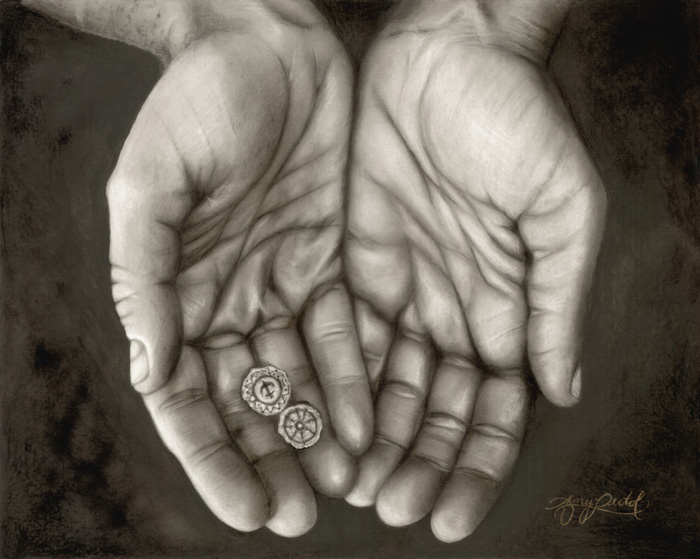
She easily could have questioned the tithe. She could have tried some similarly-slippery Scribe-like reasoning to weasel her way out of worship:
“Jesus, do I really have to tithe? I mean technically it’s impossible to tithe off of two coins, an amount that can’t be divided by 10, right?”
She saves her words and just obeys. She gives all she had. Instead of arguing, questioning, and trying to “figure it out” she just goes ahead and gives all she has. No calculating or scheming.
Just surrendering. So today we:
FOCUS on simply surrendering everything to Him.
Reflection for today: Is there any area of your life you’re struggling to trust God? Are you peppering Him with questions instead of simply obeying? Is there any portion of your heart, your time, your finances, or your family, where you sense you’re still fighting for white-knuckled control? Spend time quietly with Him and ask Him if there’s anywhere He wants you to simply surrender this week. Thanks for reading.
FOCUS: On the sacred celebration
Monday’s Reading: Matthew 21:12-22, Mark 11:12-19, Luke 19:45-46, Luke 21:37-38
“Jesus entered the temple and drove out all who sold and bought in the temple, and he overturned the tables of the money-changers and the seats of those who sold pigeons. He said to them, “It is written, My house shall be called a house of prayer, but you make it a den of robbers.” Matthew 21:12-13
~
 Just as I started typing this post Jeff came into the office holding a box. “It came!” He announced, grinning ear to ear. I lit up. “Oh yay! That deserves a writing break.” I slid the computer off my lap and opened the box, pulling out the new garment and admiring the vibrant blue color. We’d received a coupon and a dividend, and Jeff insisted we use it on a special treat for me: a cozy fleece North Face sweatshirt. I immediately tried it on and admired the great fit. Although I hate shopping, I had to admit, It is kind of fun to get new stuff. You know the feeling, right? There’s this slight thrill that runs through your body, a rush that brightens your mood, makes you feel more motivated, more confident.
I glanced once last time in the mirror. I did look pretty cute in the new sweatshirt.
I walked into the office and slide the computer back on my lap to finish this post. Then it occurred to me what the topic for today just happened to be.
Funny.
See, on Monday Jesus arrived in Jerusalem and entered the temple. It is not a sweet and peaceful scene. This is kind of a scary one. Jesus only loses His cool one time in Scripture and this is the time. Even when He’s beaten, scourged, and hung on a cross He is in complete composure, but this, this scene in the temple sets Him off, holy anger consumes Him and He’s enraged, overturning tables and chairs, driving out the peddlers, refusing to let anyone carry anything through the temple. Why? Because, as He said, “My house shall be called a house of prayer, but you make it a den of robbers.” God intended the temple to be a sacred place where man and God commune, but people had turned a holy ritual it into a money-making venture.
I’ll say it again: They had turned a holy ritual into a money-making venture.
I’m mostly going to let this application speak for itself. When we look to Jesus we see Him ticked off about letting sacred celebrations turn into crass commercialism, turn into a money-changing event.
I know that sweet little thrill of buying new stuff. (Hello, I’m wearing my new sweatshirt as I type these words.) But we must be mindful of this lure and continually look to Jesus who brings focus to our lives.
Again, this isn’t about a boycott on bunnies, it’s simply a call to:
FOCUS on the sacred celebration, not the Easter items to buy.
Reflection for today: What material items are most important to you during this season? Is there anything perhaps you could go without this year, for the same of simplifying and keeping the focus on the sacred celebration? Not saying every purchase is forbidden, but consider which purchases are really necessary to help your family FOCUS on Christ. Thanks for reading.
FOCUS: What we really need
Sunday’s reading: Matthew 21:1-9, Mark 11:1-11, Luke 19:29-38, John 12:12-15.

And the crowds that went before Him and that followed Him were shouting, “Hosanna to the Son of David! Blessed is He who comes in the name of the Lord! Hosanna in the highest!” Matthew 21:9
~
I knelt down in the dark, face down to the carpet, and let me prayers, complaints, and requests flow freely. Several minutes in, I had to pause. I rewound briefly in my mind:
Almost everything I had prayed thus far was concerning circumstances and temporal things.
Earthly stuff.
Now, that’s a great place to begin in prayer. But if that’s where I stay, I’m bound to be disappointed. And today is the perfect time to FOCUS our hearts on something deeper, something real. What we need most.
See, Hosanna simply means “Save now!”
The disciples and the multitudes were expecting Jesus to establish an earthly reign. They wanted an earthly Kingdom. They wanted freedom from the oppression of the Romans. They wanted Jesus to forcefully seize control of the political realm and establish an earthly reign in Jerusalem. And this kick-off event of the Passion Week reveals their anticipation that Jesus would indeed be their new king. They wave the branches and lay down their clothes, getting ready for Jesus to take over and reign.
But then He goes and dies instead.
All along Jesus kept emphasizing that His Kingdom was not an earthly one. He kept upsetting their expectations. Kept turning everything upside down. The least is the greatest. Humble yourself to be exalted. When asked by Pilate if He is king of the Jews, Jesus responds plainly: “My Kingdom is not of this world.” But no one seemed to understand all this.
Do we?
His purpose all along was to reach down to earth that He might bring deliverance to His people and populate The Kingdom of Heaven.
How often I seek the wrong kind of salvation. How often I forget that Jesus didn’t save me in order to set up a glorious happy Kingdom here in this life, on this earth, for me. This earth and everything in it is passing away–merely a breath. I spend probably 90% of my life and time and energy praying and thinking and asking for blessings here on earth. And don’t get me wrong, I want to receive them!
But how much better to pray, ”Thy Kingdom come, my kingdom go.”
When I cry, “Hosanna–Lord save now!” what does that really mean? If I were really to spell out what that often means in my heart it’s probably,
“Hosanna–Lord save me by giving me good sleep and by making my husband really happy all the time and by making him always do the things which please me and by making my children behave all the time and become really smart, and by blessing us financially and making me a really successful author and by keeping every day exciting and fun and by always giving me success. Yes, Lord! Save now!”
Christ really came to save us from sin. He came to set us free from ourselves. What if our Hosanna! meant:
“Lord, save me from my pride, my greed. Save me from making choices that lead toward destruction. Save me from hoarding my resources, from grabbing and insisting things are mine. Save me from my ego which always wants more praise and glory. Save me from despair and hopelessness which discounts Your power and faithful provision. Save me from my moodiness and touchiness that makes me easily hurt. Save me from impatience with my kids, save me from unkindness toward my husband. Oh Savior, save me from myself. Your kingdom come, my kingdom go.
So today, as you look to Jesus:
FOCUS on seeking God for your real needs.
Reflection for today: When I pray “Save now!” what do I really mean? Am I asking for earthly comfort or the Kingdom of heaven? What might be your deepest heart-need right now, and how can you make that prayer of primary importance this Easter season? Thanks for reading.
God is looking for losers

I stood at the sink and shook my head, trying to pin down the vague heavy feeling of discouragement that had plagued me for a few days.
“I’m just not winning anywhere,” I finally admitted. Then smiled, “I know you know the feeling.”
Jeff smiled and nodded, pulling me close into his arms, not taking offense because we both know it’s true. These early days of church-planting can sometimes feel disheartening. “Planting” is by definition a season of pushing seeds deep down underground (that is, where they are unseen) and then watching and watering and waiting. (Heavy on the waiting party.)
Planting season is heavy on labor, light on harvest. If you’re prone to evaluate things based on immediate visible results, planting is not the business for you. (Or parenting, for that matter.)
But planting is the business for us, for now, and we thoroughly enjoy it and the blessed saints surrounding us and the adventure each day brings. But we live in a celebrity culture which idolizes winners, champions, stories of success. Fair enough. Our Lord was a victor, a winner, a champion. He successfully conquered sin, death, and the grave.
Some days I can’t even seem to successfully conquer the laundry.
And no one celebrates when I sweep up crumbs for the zillionth time and put another meal on the table.
My own mundane life is juxtaposed with the laughing, flawless “winners” who grace every screen, page, billboard and stage.
This week I read an interesting article, a critique of the “radical” movement which calls Christians to abandon American comforts and live lives of sacrifice. While I wholeheartedly embrace this movement, the author made an interesting observation, pointing out that the “radical” literature still elevates a “winning” American mentality, celebrating big-name and big-splash acts, saying:
By contrast, there aren’t many narratives of men who rise at 4 A.M. six days a week to toil away in a factory to support their families. Or of single mothers who work 10 hours a day to care for their children. Judging by the tenor of their stories, being “radical” is mainly for those who already have the upper-middle-class status to sacrifice.
Nor are there many stories of “failure”—of people sacrificing without visible signs of transformation. As a result, many of the narratives implicitly convey that the reason to go and die is the gospel success that will follow. In most stories, the results come during the lifetime of those who decided to “come and die.” [Rather], God’s “greater” often seems like disappointment and failure, and that in our “most dire moments [God] seems almost absent.” Given how prevalent such moments seem in the Christian life—and in Scripture—they are disproportionately underrepresented in the “radical” literature.
Just this week, on a low morning, I opened God’s precious Word and found myself sitting with David in 1 Samuel. In one of my favorite passages, I re-read of David fleeing from Saul, hiding in the cave of Adullam, and receiving those who gathered around him. Who rallied around to support him?
“Everyone who was in distress, everyone who was in debt, and everyone who was discontented, gathered to him. And there were with him 400 men” (1 Sam. 22:2).
Four hundred losers!
Sweet dream-team, David.
They were not glowing examples of victorious living. They were not the “winners” I would have chosen for my team. But this was David’s army, and David led these men to victory.
Again and again and again.
We all “know” this truth, but it bears repeating.
God is not looking for winners. He’s looking for losers.
He’s looking for those who will lose. Lose their money. Lose their comforts. Lose their reputations. Lose their pride. Lose their lives.
Even Jesus’ win came through a loss.
His life came through death.
And the truth is that most the “winners” in Scripture weren’t considered winners during their lifetime. They never “achieved” or arrived. In the great Hall of Faith we read,
“These all died in faith, not having received the things promised, but having seen and greeted them from afar, and having acknowledged that they were strangers and exiles on the earth” (Heb. 11:13).
And these “losers,” Scripture says, are those “of whom the world is not worthy.”
The world and all its titles–Winner, Champion, Celebrity–isn’t worthy of those blessed “losers” in scripture who “did not receive what was promised” …
but persevered anyway.
God is looking for these kind of losers. To be His hands and feet, who will care not for glory or reputation, for praise or celebration, but who will simply, quietly, faithfully love His people, feed His sheep, and give cups of water to His little ones.
If you look around and you’re “just not winning anywhere,” keep on losing, keep on loving, keep on trusting, keep on giving.
Keep on believing.
God is looking for losers just like me and you.
{Thanks for reading.}