


All the more, Encourage.
And let us consider how to stir up one another to love and good works, not neglecting to meet together, as is the habit of some, but encouraging one another, and all the more as you see the Day drawing near. Heb. 10:24-25
A few things are concerning me right now, and none of them are Covid-19. That’s not discounting or dismissing the danger of the virus (it’s real!) and it’s not a political statement. I’m not concerned about whether or not I have to wear a mask in the grocery store. I’m not even terribly concerned about when we’ll be able to gather in a large-group, in our church building (though I am SO looking forward to that!).
I’m concerned that we, and we includes me, are getting distracted from our calling, purpose, and mission.
In January, as I asked God whether He had a word for me for 2020, a sort of guiding direction for my life, I was not a little surprised when I clearly heard, “Encouragement.”
Encouragement?? What sort of word is that? It isn’t even a Verb! I’m a verb girl, God!
Encouragement. It felt a little flat, honestly. But I wrote it down, and purposed to figure out what on earth God wanted me to do with it.
In March, I attended a workshop titled, “How to Have Difficult Conversations.” I didn’t want to go, but I knew I needed to, as even the mention of difficult conversations makes me break out in hives. I hate them, I’m bad at them, ministry is full of them—I went.
At the bottom of the handout was a Recommended Reading list, and the #1 recommended read was a book called, ready for it?
Encouragement.
Written Larry Crab and Dan Allender (I love them both!), I had a hunch this was probably the direction God was going with me. I bought it.
It’s a short book, but I’ve been going through it slowly, because it’s so good and I’m wrecked by how short I fall of being an truly encouraging person.
In short, to be an encouraging person, my overarching goal, in every personal interaction, is to minister to that person. That is, my goal is to listen and seek understanding so that I can become aware of the person’s hidden fears (we all have them) and speak words from love and targeted toward diminishing, and destroying, that fear.
How often do I go onto Facebook with the goal of seeing who I can encourage today?
When I’m getting ready for church in the morning do I ask God how I can be an encouragement to others today?
When I interact with my children, my husband, my housemates, do I inwardly seek opportunities to speak encouragement and life into their lives?
Sadly, the truth is, most often my underlying goal is some form of self-protection. Looking out for self. Defending self. Ensuring I’m not hurt. Guaranteeing my viewpoint is heard. Championing my view.
Why is it so hard to set aside self for the sake of encouraging others?
I can’t speak for anyone else but me: For me, it’s because it is terrifying to completely let go of looking out for self. Who will look out for me?
To give ourselves to the encouragement, strengthening, building up, and blessing of others, means abandoning ourselves to the care of …
God.
I don’t say this flippantly. Letting go of looking out for self isn’t an abstract thing—it plays out in real life, flesh and blood ways that sometimes feel painful. But isn’t this what we’re called to? Isn’t our purpose, as followers of Jesus, to seek the good and welfare of others? Aren’t we called to consider how to stir each other up toward love and good deeds, encouraging each other all the more as we see the day approaching.
I do believe that there is crazy stuff going on in our world. It sure seems like we are seeing the day approaching! But I can get so caught up in it that I completely forget what God told me to do in these days that we’re in!
Encourage. Reach out. Listen. Try to understand what’s going on beneath the layers. People are afraid, and it’s not just the people wearing masks.
I have definitely been battling discouragement, for a variety of reasons. And I’m struck by the fact, again and again, that I don’t usually find courage, strength, energy, and resolve by someone posting another click-bait news article on Facebook, or someone “speaking out” on another issue.
I’m encouraged when someone listens to me. When someone checks on me and asks how I’m doing. When someone send me a funny meme or gif or message that says they identify with how I’m feeling. Even when someone who loves me cares enough to speak a hard word about why I’m discouraged, identifying an idol that’s robbing my joy. Hard words, spoken from people who love me, are welcomed!
So I’m writing this to myself first and foremost. Writing things is a form of accountability for me. I endeavor to be an encourager. I think it’s critical we keep this front and center, all the more as we see the day drawing near.
Thanks for reading.

Are we supposed to resist evil or not? What did Jesus really mean?
I quizzed my kids the other day by reading them part of an article by Deepak Chopra and asking them whether it was true and theologically sound. It brought up a great discussion, the gist of it was this:
Are we to resist evil or not?
In the cited article, Chopra states that Jesus told his followers in Matthew 5:39, “Do not resist evil.” He went on to say that Jesus “gave in to evil and is worshipped for it.” He then blasts Christians by saying that they ignore this teaching and instead “seek revenge” on terrorists, Nazis, murders, and pedophiles. Apparently, Chopra thinks that Jesus words in Matthew 5 (and His going to the cross) mean that Christ-followers should never resist wrongdoing in this world. He concludes, “Now that … punishing all evil-doers to the absolute maximum is the most Christian thing to do, we can all rest easy. Jesus’s most radical ideas have been washed clean from our memories and our conscience.”
A few thoughts:
- First, he misquotes Jesus’ words. Just a slight twist, but it’s in there. My ESV says, “Do not resist the one who is evil.” Some translations say, “Do not resist the evildoer.” In the Greek it literally reads, “Do not resist THE evil.” The word for evil can be translated an evildoer, or just evil. But no matter how the English comes out, it’s clear that Jesus isn’t just making a blanket statement, “Do not resist evil.”
- Jesus came “to destroy the works of the devil” (1 John 3:8). Obviously the works of the devil are … EVIL. How can you destroy something without resisting it? Clearly Jesus came to resist and to destroy evil.
- James tells us, “Resist the devil” (James 4:7). If we are never to resist evil, how on earth would be resist the devil? Is it possible to tease the two apart? I can’t imagine how on earth you would do that.
So what is a Jesus-follower to do?
Follow Jesus exact words, His methods, His ways.
Jesus overturned evil by personally suffering evil. He resisted evil by refusing to retaliate. The context of Matthew 5:39 is Jesus saying, “Turn the cheek. Offer the cloak. Go the second mile.” When mistreated, Jesus is saying, “There’s actually a better tactic than just merely resisting (or retaliating against) the person mistreating you.”
Don’t fight the person, fight FORCE behind that person.
To Chopra’s credit, though I hate to admit it, I do think some of his observation is correct: As a whole, we Christians haven’t done a great job of enduring personal mistreatment. We’re a very quick lot to defend ourselves. But he’s also mangling Jesus’ message, and (it seems) using the criticism to discredit Christianity as a whole. That sort of sloppy theology and finger-pointing isn’t super helpful, in my opinion.
There’s a lot more I’d love to say, but for now … What do you think? I’d love to hear your thoughts!

How to swap out the soil of our hearts
“It’s all about soil.”
I spoke this across the room to Jeff, out of the blue, while in the middle of reading Red Fish, Blue Fish to Justice. He looked at me, completely lost.
“That’s it. Same external environment, same seeds, same treatment, same timeframe. One pea planting is 3-feet high and one is 3-inches. It’s all about soil.”
Of course he knew I wasn’t talking about plants, per se, but the observation was certainly true on that level. We re-filled all our planter boxes with premium garden soil this year, and the growth is incredible, compared with the rest of the garden. Just yesterday our housemate observed, “You’ve never had this kind of success!”
It’s true, I said. We swapped out the soil.
The deeper level comment was in response to a question I’d been wrestling with: Why, under the same circumstances, do some people seem to grow and thrive and bear ongoing fruit and others don’t?
Of course, I’m including “seem to” because we can’t truly determine what growth is happening deep down, inside. But we can certainly observe fruit! We’re told to!
Jesus sheds light on this dilemma, I think, when He talks about soil. Just as I observed in my garden, Jesus clearly says that the key, in whether the seed of the gospel bears fruit manifold or not, simply comes down to soil.
“And some [seed] fell into good soil and it grew and yielded fruit a hundredfold.”
Luke 8:8
So then the question is: What is good soil and how do we get it?
It seems to be two-fold. In Luke 8:15 Jesus says, “As for that in the good soil, they are those who, hearing the word, hold it fast in an honest and good heart, and bear fruit with patience.”
Good soil: Honest and good heart. Patience.
But in Matthew 13:23 Jesus says, “But the seed falling on good soil refers to someone who hears the word and understands it.”
Good soil: Hearing God’s Word and understanding it.
Which is it? Yes.
As much as I’d like to blame external circumstances, the condition of my heart is the variable that determines the fruitfulness of my life.
And while that can feel defeating, as if I’m doomed to a life of stunted growth because of my bad soil, the opposite is too. Just as we were able to switch out the soil in our planter boxes, you can swap out the soil of your heart.
Our new soil cost us $114 and a good hour of shoveling (ok, Dutch & Jeff did all the shoveling). New soil in our hearts is going to take a much bigger investment, but friends: Nothing else matters more. Using Jesus words, we could safely say the swap out entails:
- Pursuing honesty and integrity, before God and others.
- Accepting difficulty and delays with patience.
- Regularly receiving the Word of God and working to understand it.
There are other aspects to the parable, of course. The cares of this world and the deceitfulness of riches choke out the seed. Shallowness makes the seed spring up quickly with enthusiasm, then die in the face of difficulty. Lack of understanding allows the enemy to snatch away the seed before it has a chance to bear fruit.
But really, it’s all about the soil.
What we desperately need, what I desperately need, is to do the work of swapping out the soil of my heart by continually pursuing those three things. We don’t have control over our circumstances. We might be “free” but we are most certainly not in control. We don’t get to choose what plague or persecution will face us in our lifetime, but we do get to choose whether or not we will make the priority of pursuing good soil in our hearts, so that God can bear fruit a hundred-fold in our lives no matter what harsh environment comes our way.
{Thank you for reading.}
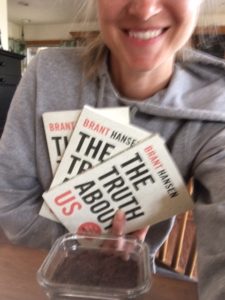
The Truth About Us
Who would have thought that a book about cognitive biases, self-righteousness, and Adolf Eichmann, architect of the Nazi’s “final solution,” could have me laughing out loud and breathing a deep sigh of relief as I settle into the realization, all over again, that I can indeed lighten up and let God be God.
Letting go of self-righteousness might be the most freeing thing we ever do. It’s a slow and subtle trap and it feels so right all along the way. The “righteous indignation” we nurse as we look at the world around us, the fierce loyalty we feel towards our party, our camp, our opinion, the airtight case we silently build as we mentally dispute those who disagree with us.
It’s a full-time job, y’all, having to be right all the time.
The truth is: You guys, we’re a mess. Salvation can’t come until our prayers are no longer looking around at those we deem losers and saying, “Thank you, God that I’m not like THEM,” but we finally, inwardly, truthfully, just beat our chests and go, “Oh my goodness, Lord Jesus, have mercy on me, a sinner.”
The chest-beaters, the mess-ups that know it, the ones with eyes downcast, not looking around at everyone else, they’re the ones who will be justified.
For me personally, the book spoke loud and clear one thing I needed to hear: Lighten up.
When did the weight of following Jesus become SO VERY HEAVY? When did we start believing we have to have an opinion on everything? When did everything become a cause of outrage? When did I become so easily overwhelmed by the everyday struggles and conflicts of life?
None of this is new. Kari, there is good news. It is that Jesus has inaugurated a New Kingdom and it’s totally upside down and all this stuff we see is but a shadow and He actually said that His yoke is EASY and His burden is LIGHT. Why? Not because the work is easy, not because the weight of the world is light, but because HE CARRIES IT.
This whole wild circus that we call the World?! Jesus isn’t freaking out. Jesus isn’t panicking. In fact, He’s SITTING DOWN. He’s seated at the right hand of the Father and He’s patiently waiting to return and set everything straight, and as I cling to Him and trust Him, and seek justice and love mercy and walk humbly with Him, He’s going to go ahead and run the world and in the end I’m pretty sure I’ll be wrong about more than 1/2 the things I think I’m right about. But if I have trusted Him and walked in humility and fled from sin and pride, I think there will be a place for me, with Him, in a great eternal kingdom. Oh man, you guys: I’m so so glad for this.
So yeah, buy the book: Looks like the best deal is here: https://bakerbookhouse.com/products/the-truth-about-us-how-we-fool-ourselves-and-how-god-loves-us-anyway-9780801094514 Or if you live near me, you’re welcome to borrow one of my three copies. 🙂