

#50 Evaluate your home {52 bites}

I’ve been spring cleaning my home all week, going through room-by-room and cleaning, evaluating, de-cluttering. I’m also writing Chapter 6 of Sacred Mundane which is about our homes. Tonight we’re having dinner with some friends who just sold their home. They’ll be moving into a Grandmother’s home until they find their next space. This morning some dear friends move in (temporarily) to our daylight basement downstairs. They are living part-time at a parent’s home and part-time in our home.
Homes are on my mind.
Jeff and I have lived in 13 homes since getting married almost nine years ago. A 2,000 square-foot-home a friend let us rent for $600, our first townhome, a windowless fire-hazard cave in San Jose, the creepy Acropolis Apartments with Aaron & Candi, another townhome in McMinnville, a bigger home in McMinnville, my parents’ home, my brother’s home, the Dombrow’s home, a West Linn apartment, our “dream home”, and now our beloved rental, affectionately called The-mobilehome-on-stilts.
Though I still care about “home,” it’s a bit of a four-letter-word for me. You see, I think the notion of “home” became an idol for me. Ever since I can remember I dreamed of homes, drew drawings of homes, looked at pictures homes, equated that “perfect” home with that “perfect” life. A cotton-candy dream, to be sure.
Now, I’m a recovering home-a-holic.
God extracted my idol like a bloody tooth from a jaw. Many of you followed our downsizing adventure of selling our dream home and moving into our precious 70s rental. It truly was one the best decisions we’ve ever made, and every time I drive by our old house I thank God we’re free from that mortgage. But this past week, I’ll confess, I caught a case of the Rental Blues. House prices are so low, and interest rates are so low, and if we snagged a Foreclosure-Fixer we could pay it off in no-time. So earlier this week I peeked, and quickly developed a crush on a foreclosure nearby. That night I asked God if He’d make it clear whether I was supposed to continue my crush. The next day it sold. We’re staying put.
And happily staying put, I might add. The friends who are surrounding me today remind me that home is wherever you hang your hat, where you laugh with friends, where you can just be, even if you don’t know how long you’ll be there at all.
The essence of this step, then, is to objectively evaluate your current home and determine if you can make it work or if you need to find a new spot.
Here are some questions Tsh suggests:
1. Is the central living area of our home usable for our
family?
2. Does the kitchen function effectively as a place to cook?
3. Are we able to sit down together as a family for meals?
4. Is everyone in the family able to pursue their interests
because of our home?
5. Does the layout of our home provide us the right balance
of togetherness and alone time?
6. Do we like the amount of light in our home?
7. How do the colors in our home make us feel?
8. Is our home in a location that works for our family?
9. Does our home fit our budget? (Dave Ramsey and
others recommend your rent or mortgage not be
more than one quarter of your take-home pay.)
10. Are we at peace in our home?
Our current home satisfies all these requirements. Of course I would still love to own a home outright someday and be free to give and travel more, but this is our home for now and The Nester offers some great words on embracing the home you have now:
My next house is going to be beautiful. It might not be bigger but, my next house is the one I’ll really make into a home. This house we are in now is just a holding room for us until we get to our next house. It’s ok that it doesn’t represent our family. I’m renting, it’s a waste to make it pretty right now. I don’t know how long we’ll be here. I long to have a much loved haven for my family but, I don’t have the funds and those pictures in the magazines assure me that it’s impossible to even attempt to make a change where I am. Yeah, I’m gonna love my next house. You’ll see.
How many of those lines have you repeated to yourself? I’ve said them all. And then I finally realized that there might not be a next house.
Love where you are. Beautify where you are. Your next house will be great too but, wherever you are right now, today, has enormous potential.
Compared to your last house, this IS your next house.
Another great way to start fresh without starting over comes from this post on Resetting a room through a fresh pair of eyes. Love this idea; I’m going to do it!
Consider evaluating your home this weekend and determining if you need to make it work or find a new spot. Here are some great links to more thoughts as well:
- When your house-attitude needs a paint job
- Cool of house-fever with a long-term financial plan
- Confessions of a Reluctant Renter
{May you be blessed this weekend as you evaluate and enjoy the home you have now… thanks for reading.}
Disciplining Daffodils.
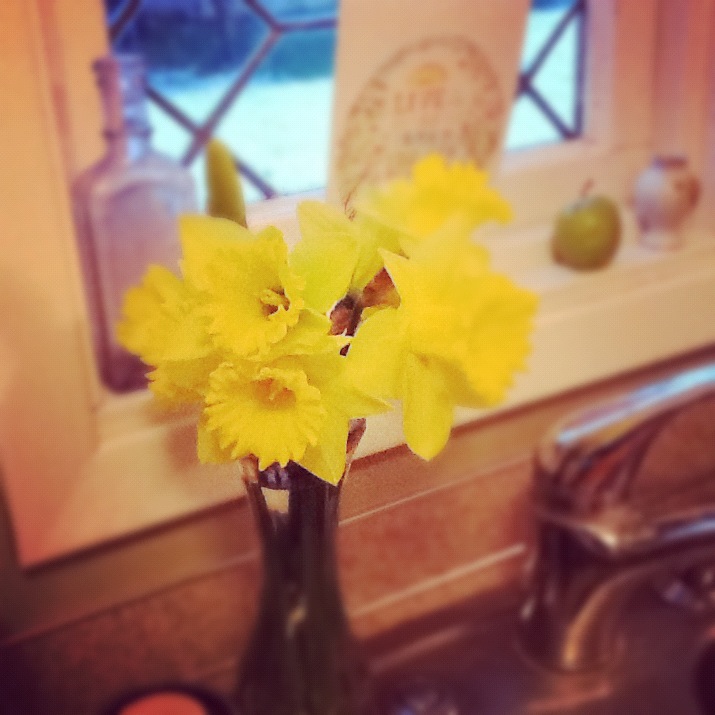
It was March 13th and there was 6 inches of snow outside. For adults, snow in March doesn’t hold the same wonder as snow in December. But children know no seasons.
Snow is snow and my kids were crazy with excitement.
Not that “crazy” was a new way to characterize them. They were fabulous on our vacation, truly. It was delightful. But, consider — we were on a vacation in Hawaii. It’s not that hard to obey when it’s 84 degrees outside and you’re playing in the sand. 🙂
Back home it was a little harder. They weren’t necessarily disobeying or defiant, they were just wired. Crazy. They giggled and wiggled and spun like tops and fell out of chairs and I kept asking God for patience and consistency to help them get their minds and bodies back into the swing of reality.
Then it snowed.
Like gasoline to a flame is snow to a hyper child.
So after our chores I said yes, we could go outside to play. Socks, sweatshirts, gloves, hats, boots — they were finally ready and I sent them outside for two minutes by themselves so I could get my own boots and coat and join them. As soon I closed the door and turned around …
THUD.
Scream.
*Deep breath*
Open the door. Heidi is bawling, snow all over her face. Dutch’s eyes are wide, frantic, guilty.
“I didn’t mean to hit her!” (Didn’t mean to throw a snowball in her face?!)
I didn’t yell. (Thank you, Lord for grace.) I gathered Heidi up in my arms, brushed the snow off her face. Dutch started walking away to go play in the snow.
Not so fast, darlin’.
The snowball wasn’t malicious but it was foolish. I explained to Dutch that he was not showing self-control, and told him to go stay in his room, in bed, to practice self-control while Heidi and I played outside.
He. Was. Devastated.
Right or wrong method, that was my choice and I could tell it broke his heart. It broke mine too. He’d had his heart set on playing in the snow and Heidi didn’t even care that much about being outside. Snow is his favorite thing. He went to his room, crying, pleading to go outside. I stood still at the doorway, holding Heidi, listening to him cry from his room.
Outside in the snow were Daffodils.
Daffodils, blooming brilliant yellow on this March day, were buried in six inches of snow. You could barely see their bright faces bowed down low, weighted with snow. Suddenly it was silent and I heard a verse I didn’t know by heart:
“Discipline him while there is hope, do not set your heart on putting him to death.” Proverbs 19:18
Disciplining daffodils.
I had to do it or they would die.
I quickly set Heidi on her feet, looked into her confused face: “Trust Mama.” She did. I went inside and grabbed scissors. Returned. Took her hand in mine and led her out into the snow. We took each weighted daffodil, snipped the stem down low, gathered them in our hands and carried them inside.
The warmth of the kitchen enveloped us. I breathed gently on the flowers, melting the snow, arranged them in a glass vase by the kitchen sink. They still drooped sadly, and I thought it might be too late, the ice had made a few petals translucent, like frozen lettuce. I’d just have to wait and see.
By now Dutch’s room was quiet.
There is still hope; I will not set my heart on his death. I took Heidi back out in the snow.
As we played, he thawed.
Left alone, our children are buried low under the weight of sin.
Though painful, we must cut those stems and save them. While there is still hope. If we ignore it, we set our hearts on putting them to death.
I had to save the daffodils. I have to save my son.
After awhile, I went inside. Peaked my head in his door. His tear-stained face beamed bright in a smile, “Mommy, I have self-control!!” With a tear-filled laugh I gathered him up, smothered him with kisses and told him it was time to go play.
And play we did.
Today, the daffodils are tall and bright. The snow is gone. They were saved.
{Thank you for reading.
Thanks, hon, for taking the picture so I can remember…}
Bending my will in order to bless …

*Last summer, when in London, we had the joy of meeting a Sacred Mundane blog-reader, Brie. She and her fiance Jamie gave us a fabulous tour around the River Thames and a delightful evening of fun and fellowship. Jamie and Brie are now married, and I’m delighted to share a few of her thoughts with you. Enjoy!
—
We did this crazy thing last year – we got married.
Two completely imperfect people tying themselves together, to the perfect God and saying, if you’ll let us, we’ll bring glory to your name, let our story speak only of You. And it is a completely crazy thing, when you think about it. I’m difficult and stubborn and selfish, I desperately want my own way, I am a perfectionist; and my husband, he has to be just as flawed, because he’s only human. And these two sinners are going to try to build a life, and this is going to bring God glory? How’s that? How can that be possible?
I should probably mention here that God’s never-failing sense of humor has appeared in our marriage, He took two of the most independent people ever – we both moved to a new continent in our twenties, and we live in one of the most independent, hard, economically-driven cities in the world – and gave us to each other. But do you know what else he gave us? Jesus. Thanks be to God!
And so this marriage, it would be completely crazy, if it were only the two of us – we’d probably disagree constantly, and keep long accounts, and struggle to get our own way every time, and expect too much, and love too little.
But it’s not a marriage of two. It’s a marriage of three. Our wedding verse was from Ecclesiastes – ‘two is better than one…but a three stranded cord is not easily broken.’ (Ecc 4:9-11) Marriage is about the two of us, about the two of us putting Jesus in the center of it all. When we were dating we’d pray for each other in the morning via text message. We still do. My husband works long hours and often leaves the house before I am awake, and so often my morning starts with a text he’s sent while on his commute, praying for something he knows I’m facing that day, the knowledge that he takes me to the feet of the Most High God humbles me.
I thought marriage was about a clean house and nutritious meals, and in some respects it is, but only because it’s about bending my will to serve my husband; and ultimately to serve Christ. The laundry? And the bills? And the shopping? They are the mundane things that our days are built on. But as Kari says so frequently, they are sacred. Sacred because that specific task has been ordained for this moment; and sacred because God has gifted me with this blessing of a man and asked me to love him, to serve him and in so doing, to glorify the name of Jesus. And how do I love and serve my husband? By doing the laundry and cooking a meal and knowing that he loves fresh sheets on the bed and he thinks it’s a treat to have orange juice in the fridge.
When considering that our marriage is to reflect the love Christ has for the church to the world, suddenly my small, sometimes seemingly mundane marriage, feels weighty. And I wonder, do we? Do we love each other sacrificially, unconditionally, and completely? Probably not. But today, with God’s help, we will.
{Amen, Brie! Praying that same supernatural help for us all today as we imperfectly love with Christ’s perfect love. Thanks for reading.}
—–
Brie Doyle UK-based Canadian, recently married to a Kiwi, and seeking after God’s will for her life and marriage. She relishes coffee dates with Jesus, cooking (but not cleaning) and seeing God’s glorious creation through travelling. She writes at on a wing and prayer.
Too much like the real thing

*Related to our talk last week of following Christ from afar … consider:
Abbot Peregrine, a Benedictine monk in the 1600s, is having an ongoing conversation with a well-intentioned friend who is criticizing the Abbot’s insistence on such a brutally low standard of living for himself and his brothers. The friend’s critique is that poverty simply means renouncing ownership, dressing in simplicity, and saying of nothing “this is mine.” But, the friend insists, certain pleasures are simply the bounties of God’s immense kindliness, for there must be some pleasure in life! The line that grabs me is this:
His friend says, “Moderation! You ask too much! Your self-imposed penury is not holy poverty. It is like the poverty of the world. It is …”
“Too must like the real thing, you mean?” Abbot Peregrine interjects wryly.
Too much like the real thing.
Too much like the real thing. The friend’s plea was moderation! Moderation. While moderation is a great plan to follow in dietary habits, it is nowhere given as a prescribed manner of following Christ. In A Realistic Look at Living on Less we talked about how going without actually feels like going without. Humbling ourselves actually feels … well, humbling. We readily embrace–in theory–that suffering for Christ is part of our call as Christ-followers, but then when someone is actually suffering we are quick to insist that it’s not from God. Peregringe embraced a life that made him poor in Spirit, making outward choices to lead his heart into a greater dependence on God.
My point is this: When we settle for less than the real thing, when we settle for merely the appearance of humility or giving or faith, we miss out on the joy, the grace, the favor, the fellowship with God that only comes through really entering into His suffering, His pain, His love. Those who are poor, not on the outside, but on the inside are those who possess the Kingdom (Matthew 5:3). There is no inherent virtue in having a less crowded house, but it can lead to a less crowded heart.
{Pondering these thoughts today … thanks for pondering with me.}