


How to pray for our country
I read the article, another political one, and closed my eyes in the car.
“I don’t even know how to pray,” I confessed to Jeff. The urge is everywhere, “Pray for our country!” But how? Everyone has their own opinion, and it can feel dizzying at times.
Then,I find myself reminded of Christ’s method:
Men were His method. That is, people. People were his plan for reaching the world.
So then, we pray not “for our country” in a vague sense, but we pray for people. Specifically 1 Timothy 2:1-2 says,
“I urge that supplications, prayers, intercessions, and thanksgiving be made for all people, for kings and all who are in high positions, that we may lead a peaceful and quiet life, godly and dignified in every way.”
1. PRAY FOR LEADERS
Robert Coleman echoed this in His classic book, The Master’s Plan of Evangelism:
“There is no use to pray vaguely for the world. The world is lost and blind in sin. The only hope for the world is for men and women to go to them with the Gospel of Salvation, and having won them to the Savior, not to leave them, but to work with them faithfully, patiently, painstakingly, until they become fruitful Christians savoring the world around them with the Redeemer’s love.” (109)
2. PRAY FOR LABORERS
Yes. We are to pray for people. And specifically, we are to pray for leaders, and then pray that laborers will go out into the world and make disciples, that is, to bring in a harvest of souls who will know, love, and follow Jesus Christ as King. Jesus says clearly,
“The harvest is plentiful, but the laborers are few; therefore pray earnestly to the Lord of the harvest to send out laborers into His harvest” (Matthew 9:37-38).
3. PRAY FOR LIVES ROOTED IN CHRIST
Notice in the 1 Timothy 2 passage, our prayer for people (esp. leaders) is linked to a lifestyle of Christlikeness — one that is peaceful, quiet, dignified, and godly. I dare say we all could use a dose of that in today’s political climate! Henri Nouwen, writing on Christian Leadership in 1989, wrote these timely words that seem especially applicable today, in the climate of our country.
“I have the impression that many of the debates within the Church around issues such as … homosexuality, birth control, abortion, and euthanasia take place on a primarily moral level. On that level, different parties battle about right or wrong. But that battle is often removed from the experience of God’s first love which lies at the base of all human relationships. Words like right-wing, reactionary, conservative, liberal, and left-wing are used to describe people’s opinions, and many discussions then seem more like political battles for power than spiritual searches for truth.
Christian leaders cannot simply be persons who have well-informed opinions about the burning issues of our time. Their leadership must be rooted in the permanent, intimate relationship with the incarnate Word, Jesus, and they need to find there the source for their words, advice, and guidance. … Dealing with burning issues without being rooted in a deep personal relationship with God easily leads to divisiveness because, before we know it, our sense of self is caught up in our opinion about a given subject. But when we are securely rooted in personal intimacy with the source of life, it will be possible to remain flexible without being relativistic, convinced without being rigid, willing to confront without being offensive, gentle and forgiving without being soft, and true witnesses without being manipulative.” (p. 30-32)
I don’t know about you, but it’s easy to be discouraged and disheartened when we look at our world today. BUT, when we fix our eyes on Jesus and His Word and not the latest campaign speech, we are empowered to PRAY strategically and effectively for the lost, for our leaders, for laborers, and for our lifestyles, that we would walk in humility and Christlikeness, rooted deeply in His unchanging love.
Praying. Thanks for reading.
Why a good marriage isn’t our goal

I’m thumbing out this post on my phone while watching my littles splash in the river, screaming as they run from a vicious dinosaur in the form of their daddy. I’m happy for the chance to bask in the sun, and as I watch, my heart is so full of gratitude for this man I married.
Yesterday we celebrated 13 years of marriage. I know we’re still youngsters compared to some of you, but 13 years is at least long enough to make a few humble observations, not as those who have arrived, but at least who have had some scrapes & cuts & bruises along this bumpy road of matrimony. Of course every relationship is different, but I’d venture to say we all want a healthy, thriving, flourishing marriage.
The key question, then, is:
Why?
If we only want our marriages to flourish so that we’ll be happy, or fulfilled, or satisfied, then as soon as our marriage is no longer making us feel happy, fulfilled, and satisfied, we’ll quickly give up and move onto something else. If we’re really going to have the energy, motivation, enthusiasm and perseverance to tend and cultivate a healthy, thriving, flourishing marriage, we’ve got to have a greater reason why. And I would suggest this is the reason why:
Because your marriage is part of a far greater mission.
I believe that the reason our marriage has flourished (it’s not perfect, of course, but I love it!) is because “good marriage” isn’t the end goal. We didn’t enter into marriage for the purpose of marriage. Here’s what I mean:
Our marriages are less important and more important than we realize. By less important, I simply mean that nowhere in Scripture does it say that your sole purpose in life is to get married and be a “good wife”. We are certainly called to be a helpmeet (ezer) to our husband and to be fruitful and multiply, BUT the greatest purpose of all humankind in scripture is to glorify God, to go and make disciples, to love the Lord our God with all our heart, soul, mind, and strength and to love our neighbor as ourselves. Our ultimate purpose—showing the love of Christ to a lost world—is not dependent on whether or not you are married.
However, IF you are married, then our marriage is part of that mission, and it’s a far more important part than we may even realize. Here’s what I mean:
Our marriage was meant to nourish us and the world around us by its beauty and spiritual fruit. Fruit that we can enjoy, that our children can enjoy, that the world can enjoy—and that most of all puts on display what God is like. So our marriages are more important than we realize because our marriages are a picture of what God is like. It’s a picture of Jesus Christ and His church (Ephesians 5).
God is for our marriages. God created us to thrive in our marriages. He created marriage to be a picture of Christ and the church, a picture of His extravagant love for us. He wants the world to look at our marriages and say, “Wow! Now that’s love.” Our marriages are actually God’s evangelistic tool. He wants our marriages to be so beautiful, so lovely and strong and enduring, that everyone will want to know the God of our marriage. They will want a love like that.
And personally, I believe that this is the scheme of our enemy who wants to do whatever he can to discredit followers of Jesus and tarnish the beautiful picture of God’s love, by making their marriages are weak, wilted, defeated, discouraged. In other words, the health of your marriage is even more important than you think.
But as long as our goal is merely to “have a good marriage” we’re aiming too low and missing out on the deeper motivation, the God-given drive that will fuel our devotion and inspire us to grow in selflessly loving, respecting, submitting to, and honoring our husbands.
What if your marriage was the only picture of God’s love someone ever saw? What would they think? I pray God would grant us strength and grace to grow such grace-filled and sacrificially-loving marriages that the world can look and see a picture of God’s love. That’s a lofty goal. There’s no way we can achieve that on our own. It would take a miracle, a supernatural work of God to achieve a marriage like that. Which is why it’s the goal we need. He’ll get all the glory.
Praying God’s grace for a God-glorifying marriage that only His power can achieve. Praying for you! Thanks for reading.

Give yourself a gift (and your child the world!) this summer
I’ve realized something about myself the last few years: I love connecting people. Just yesterday I have a new friend over, whom I’ve only seen in person once but whom I’ve become acquainted with via text for almost a year. As we chatted, I couldn’t get another friend out of my mind, I kept thinking, “Oh, they would love each other! I have to connect them!” I’m already making plans to have them both over, so they can meet and be blessed.
I feel a similar satisfaction when I can connect people via books. Some of my greatest mentors, comforters, wise counselors, and yes, friends, are people whom I have never met in person. They are authors. Many of them, most of them, have long since passed into eternity, but their timeless words linger on pages and I’m always excited to introduce them to my friends.
Naturally, then, one of my greatest joys in motherhood is connecting my children to fabulous men and women through fabulous books. I am beyond thrilled that they are both taking such a liking to John Bunyon. We now have 5 versions of his story, Pilgrim’s Progress, in our home, and his characters and insights are becoming part of the warp and woof of our daily conversation. As we were hiking up the steepest hill from the pond yesterday, Dutch announced, “This is surely the hill Difficulty!”
So, knowing this, imagine my delight in offering you something today that is all three of these types of introductions, all into one. Yes, that’s right. An introduction to one of my favorite people, to a fabulous book, and to an opportunity to connect your children with not just a few, but hundreds of fabulous books. Let me explain:
First, one of my favorite people. We have never met in person, but Jamie Martin is a kindred spirit and dear friend. Over the past six or seven years, she has been an invaluable source of encouragement, inspiration. We “met” when my sister-in-law gave me a copy of her book, Steady Days, and I knew I’d found a friend. I still remember sitting on my carpet, weary and overwhelmed as a mama of two tinies, and letting her comforting, encouraging, life-giving words wash over me.
Two years later, I took a huge leap of faith and with trembling hand typed out an article to submit to her, to see if she’d let me guest post on her blog, Simple Homeschool. To my everlasting amazement, she did, and invited me to join the team from then on. I’m most certainly out of my league amongst those homeschool giants, but I’m so grateful they let me be a part!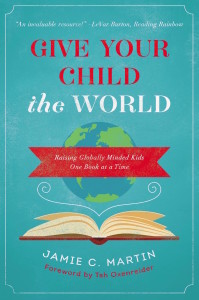
Well, this lovely lady has compiled a GOLD MINE of literature into an inspiring, encouraging, and supremely helpful book called, Give Your Child the World. In it, she shares her love for the world and her love for stories, giving personal examples of how both have shaped their own family. You cannot help but love her when you read her humble, gentle, life-giving words. She always makes me feel a sense of peace and rest, and a sense of excitement and inspiration.
Her book includes over 600 children’s book recommendation (seriously!) with stories from around the world, to give your child the gift of a love for the world, and the gift of a well-written story that encourages, inspires, instructions, shapes, nurtures, comforts.
It is impossible to overstate the power of a wholesome, well-written story for connecting with our children and teaching them every virtue. Having just read For the Children’s Sake (love!), I am convinced more than ever that whole-books are the path for an excellent education, and a rich life.
Plus, there’s a fun opportunity starting on Monday, to be part of a Summer Book Club, reading through some of Jamie’s recommendations. There are lots of perks so you can read more about that here. For now, I urge you, for less than $10 you can give your child the greatest gift–a summer (and years to come!) filled with rich stories from around the world. You can click here to order the book today. This would also be a great thing to buy if you’re a grandparent, to read aloud to your grandchildren, or as a gift to a grown son or daughter who has children.
Again, here’s the link to buy the book.
Let the summer reading begin! Thanks for reading.

More than agreement: The real goal of communication
“I just don’t know how to connect with this person,” I confided to a friend. I wanted to, I wanted to build a bridge, to connect, to find common ground, but we were just so different. I honestly didn’t know where to begin, I felt like anything deeper than surface-level conversation would inevitably lead into the treacherous waters of areas where we sharply disagreed. Emphasis on sharply. *sigh*
What should I do?
So often in this situation, we stay in the shallow waters of Safe Communication: No politics, no religion. The challenge is, pretty much all of life — except, say, the weather — eventually ties into someone’s deeply held religious or political views. It is impossible for me to communicate deeply with someone without “my faith” spilling out over into it somewhere or another. How we parent, our consumer habits, our lifestyle choices, all of this stems from our deeply held religious or political beliefs.
And I don’t know if you’ve noticed, but political and religious issues are pretty much front-and-center these days!
So how do we really connect with someone with whom we sharply disagree on critical issues?
“What do we even talk about??”
My friend, after listening to my lament, answered so plainly and simply:
“Why don’t you ask questions to try to understand where she’s coming from? Maybe you could better understand her point of view if you asked her more questions about it?”
Ha!
Well, then. Yes. Yes, that would be a good idea. The problem was, the idea of asking this person to openly divulge all her reasons for believing a certain way, for basically unloading her truckload of data for why she chose a certain lifestyle, it made my blood pressure rise just thinking about it. I could feel my heart start to race. I was physically responding to the stress of having to hear strong opinions that go directly against the life we’ve chosen to lead.
Whoa, then. There’s another issue going on, right?
See, what my friend helped me to understand was that the reason this situation was troubling to me, was that deep-down I had some insecurity, or felt threatened in some way. The reason I wasn’t willing to enter into the dangerous waters of discussing areas of disagreement was that I felt a need to defend my way. I didn’t see that there would be any way we’d ever agree, so why talk about it?
Isn’t the goal of communication to come to agreement? Isn’t that the whole point? To connect by finding common ground?
No. Actually it isn’t.
Forgive me for being so remedial, seriously I’m telling you some days I’m like, “How on earth did I get to be 36 years old and never learn this? Good grief.” But anyway, yesterday at church a seasoned saint Paul Hunter said something that about knocked me out of my chair with its simplicity and piercing truth:
The goal of communication isn’t agreement. The goal of communication is understanding.
My goal, in reaching out to someone and communicating with them for the sake of connecting with them, isn’t for the sake of agreeing. That isn’t the goal. It isn’t so that I can go to her side or she can come to mine. It isn’t even that we necessarily find “common ground.” We may not.
The goal is that I can better understand her. Understand him.
Right now I’m reading How to Talk so Kids Can Learn. I’m only a little ways in but wow, it’s so good! It’s basically saying the same thing — we must communicate in ways that we are truly seeking to understand and empathize with how our children are feeling, before we can lead them effectively into learning, obeying, etc. The goal is not compliance, it’s reaching into their hearts and carefully leading them out of selfishness, despair, immaturity, overwhelm, and into courage, obedience, excellence, love.
Easier said than done. The question was, “Did I love this person enough to put my whole heart and soul into seeking to understand her?” Did I care enough to do that, or did I just want the so-called peace of finding agreement on certain issues.
Are we willing to do the hard work of understanding the other side? Understanding others? Or do we just want to “speak our mind” or stay in the safe zone, content with surface-waters of weather when there’s so much more to be known.
Do I really want to understand my child or do I just want them to comply so I can get on with my day.
This stuff is so much simpler on paper than in life. It’s messy. We try it and fail and try it again. But it’s a noble goal, and a necessary one, especially if we are to love one another through difficult days. And even though I sometimes feel hopelessly remedial in this area, I want to learn.
I want to understand.
{Perhaps this idea will come in handy this week… Thanks for reading.}